
My Verdict
The Vortex Crossfire II 2-7x32 is a compact 1-inch brush scope that pairs a forgiving 3.9-inch eye relief with a low 32 mm profile for lever actions and woods rifles inside 200 yards. Match the 100-yard centerfire or 50-yard rimfire edition carefully to your rifle, or upgrade to the Crossfire HD 2-7x32 for a wider 2x view.
Few entry-level optics caused more box-label confusion at the gun counter than the Vortex Crossfire II 2-7x32. On any given Saturday before deer season, a buyer would bring in a 2-7x32 box they ordered online expecting a forward-mounted scout optic for an M1A, or bolt a 50-yard rimfire version onto a .308 Winchester and wonder why 150-yard targets looked slightly fuzzy. Vortex built four completely different scopes around the same 2-7x32 magnification numbers: a 100-yard centerfire version, a 50-yard rimfire version, a 9.45-inch-eye-relief scout version, and a 30 mm crossbow kit, before rolling out the upgraded Crossfire HD 2-7x32 family.
Once you put the right configuration on the right receiver, it is easy to see why timber hunters and plinkers keep buying this compact 32 mm tube. On a trim lever gun, a short-action ranch rifle, or my grandkids' Ruger 10/22, a bulky 40 mm or 50 mm objective sits too high above the comb and ruins the quick, natural pointability that makes a brush carbine fun to carry. Below, I break down how the Crossfire II 2-7x32 performs in the woods, how its past and current configurations compare, and the mounting traps you need to avoid.
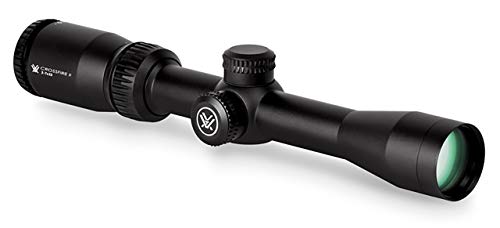
At a glance
- Magnification
- 2 to 7x
- Objective
- 32 mm
- Tube
- 1 in
- Focal plane
- SFP
- Eye relief
- 3.9 in
- Weight
- 14.3 oz
On this page
Optical Performance, 3.9-Inch Eye Relief, and Recoil Tolerance
In thick timber and creek bottoms, dropping your low-end magnification from 3x down to 2x changes how fast you can get on a moving animal, and I consider that 2x bottom end the biggest practical advantage of the Crossfire II 2-7x32. At 2x, the scope delivers 42.0 feet of view at 100 yards with an enormous 16 mm exit pupil, letting you bring the rifle to your shoulder with both eyes open and find the crosshairs instantly against dark brush. Turning the fast-focus diopter ring until the reticle is sharp against a blank sky gives you clean daylight resolution from 2x through 5x, though I notice some chromatic fringe on bright branches and a tighter, slightly dimmer 4.57 mm exit pupil once you crank all the way to 7x in late evening shade.
Shooters frequently ask me whether an entry-level 2-7x32 with a V-Plex or Dead-Hold BDC reticle can handle full-power centerfire recoil on a .308 Winchester, a .30-30, or the big-bore lever guns in my .45-70 scopes guide. Mechanically, the one-piece aircraft-aluminum 1-inch tube and nitrogen-purged erector hold zero reliably on .308 bolt rifles, 12-gauge slug guns, and standard lever carbines. Even better, I like that Vortex gave the standard Crossfire II 2-7x32 a full 3.9 inches of constant eye relief, which is more than half an inch longer than the pricier Diamondback 3-9x40 at 3.3 inches. That extra rear clearance is a major safety asset when shooting uphill or wearing a thick winter coat on a hard-kicking carbine.
Where I tell buyers to expect a budget feel is inside the capped 1/4-MOA turret housing. You get 60 MOA of total elevation and windage adjustment (15 MOA per revolution), and while the finger-adjustable dials can be lifted and reset to zero after sight-in, the click detents feel somewhat spongy and muted. I advise every owner to treat the Crossfire II 2-7x32 strictly as a zero-and-cap hunting optic: dialing it cleanly onto a 100-yard bullseye and leaving the aluminum caps threaded down keeps it tracking true for years, whereas trying to spin the dials back and forth for 250-yard target adjustments invites backlash error.
Sorting the 2-7x32 Lineup: Centerfire, Rimfire, Scout, and Crossfire HD
Before you buy any Vortex 2-7x32, I urge you to check the exact configuration because the internal parallax focus, eye relief, and optical formula vary wildly across the lineup. In particular, Vortex's newer Crossfire HD 2-7x32 generation now runs alongside remaining stock of the classic Crossfire II, widening the 2x view from 42.0 feet to 53.1 feet and expanding elevation travel from 60 MOA to 90 MOA.
| Configuration | Series & Reticle | Fixed Parallax (yd) | Eye Relief (in) | 2x to 7x FOV (ft @ 100 yd) | Elevation Travel (MOA) | Weight (oz) |
|---|---|---|---|---|---|---|
| Centerfire BDC | Crossfire II Dead-Hold BDC | 100 | 3.90 | 42.0 to 12.6 | 60 | 14.3 |
| Centerfire Duplex | Crossfire II V-Plex Centerfire | 100 | 3.90 | 42.0 to 12.6 | 60 | 14.3 |
| Rimfire Duplex | Crossfire II V-Plex Rimfire | 50 | 3.90 | 42.0 to 12.6 | 60 | 13.9 |
| Forward Scout (Retired) | Crossfire II V-Plex Scout | 100 | 9.45 | 18.3 to 5.2 | 60 | 12.0 |
| HD Centerfire Duplex | Crossfire HD V-Plex Centerfire | 100 | 3.90 | 53.1 to 14.8 | 90 | 14.7 |
| HD Illuminated BDC | Crossfire HD Illum Dead-Hold 2A | 100 | 3.90 | 53.1 to 14.8 | 90 | 15.7 |
Studying the table shows why I always match the parallax setting and reticle to the cartridge before mounting. If you shoot a bolt-action ranch rifle or an AR-47 from my 7.62x39 scopes guide, I steer you to the 100-yard-parallax centerfire Dead-Hold BDC or V-Plex version, or their upgraded Crossfire HD counterparts. If you are outfitting a .22 LR squirrel rifle, only the dedicated Rimfire versions set parallax at 50 yards so close targets stay parallax-free at 7x. Finally, watch out for the 30 mm Crossbow kit: its XBR-2 reticle is calibrated for 260 to 400 fps crossbow bolts at a 40-yard zero and does not belong on a firearm.
Four Buying and Mounting Mistakes I See With This 2-7x32
Most complaints about the Crossfire II 2-7x32 trace back to mismatched versions or ring geometry rather than defective lenses. Across the counter, I've watched four specific errors send hunters back to the bench:
- Buying the standard centerfire model for a forward barrel scout rail: Because Vortex sold the long-eye-relief Crossfire II Scout for years before discontinuing it, shoppers frequently order a standard Crossfire II 2-7x32 expecting it to work on a forward barrel mount like the ones in my M1A scopes guide. The standard scope has 3.9 inches of eye relief, not 9.45 inches; bolting it ahead of the receiver leaves you with a blacked-out tube until you move it back over the action.
- Swapping the 50-yard Rimfire and 100-yard Centerfire versions: Putting the 100-yard centerfire version on a .22 LR causes target blur and up to an inch of parallax shift at 25 yards on 7x. Conversely, putting the 50-yard Rimfire model on a .308 deer rifle survives recoil physically (it shares the same 1-inch tube construction), but introduces slight focus softness and parallax error past 150 yards.
- Ignoring the short 1.86-inch front and 1.54-inch rear straight tube spans on long actions: According to Vortex's mechanical blueprint, total mounting length is 4.63 inches, with just 1.86 inches of straight tube ahead of the turret saddle and 1.54 inches behind it. Widely spaced two-piece bases on a long-action .30-06 or .270 will hit the objective and ocular flares; always install a full-length flat Picatinny receiver rail so you can position your 1-inch low rings wherever eye relief demands.
- Using Dead-Hold BDC hashmarks at 3x or 4x in the woods: Because the Dead-Hold BDC reticle uses a rear focal plane layout, its 1.5-, 4.5-, and 7.5-MOA drop subtensions are only accurate when the zoom ring is turned all the way to 7x. In addition, those hash intervals were drawn around standard 2,800- to 3,000-fps bottleneck loads at 200, 300, and 400 yards, so on a slower .30-30 or .45-70, verify the exact yardage each hash hits on a target board at 7x.
What Stands Out
- Generous 3.9-inch eye relief across the zoom range protects against brow impact on .308 and lever guns.
- Compact 11.5-inch, 14.3-ounce 1-inch chassis with a 38.9 mm outer objective bell mounts low in 0.75-inch rings.
- Fast 2x low end (42.0 feet of view at 100 yards) enables quick two-eyes-open tracking in dense brush.
- Available in dedicated 100-yard centerfire and 50-yard rimfire parallax setups, backed by the VIP warranty.
Real Trade-Offs
- Short straight-tube ring spans (1.86 in front, 1.54 in rear) require a full-length Picatinny rail on most long-action receivers.
- Capped 1/4-MOA turrets feel soft and are strictly for sight-in, not repeated range dialing.
- Optical contrast and exit pupil drop noticeably at 7x during the last 15 minutes of legal light compared to the newer Crossfire HD 2-7x32.
Alternatives to Consider
If your rifle or hunting ground exposes one of the limits above, I recommend looking at three proven alternatives:
- For forward barrel-mounted scout rails (M1A Scout Squad, Ruger Gunsite Scout, lever-gun forward rails): Step directly to the Burris Scout 2-7x32 review. With the Crossfire II Scout retired, the Burris Scout is the premier variable intermediate-eye-relief optic in production, offering 9.2 to 12.0 inches of eye relief, better Hi-Lume glass, and a Ballistic Plex reticle in a 9.7-inch tube.
- For open-woods deer rifles that need better dusk resolution and a wider 3x view: Check the Vortex Diamondback 3-9x40 review. You gain a 40 mm objective, crisper XD lens elements, metal-on-metal turret clicks, and a 44.6-foot view at 3x, while giving up 0.6 inches of eye relief (3.3 inches vs 3.9 inches).
- For an ultralight, American-assembled deer scope on standard bolt rifles: Read the Leupold VX-Freedom 3-9x40 review. At 12.2 ounces, it trims over two ounces off the Crossfire II 2-7x32, handles low-angle backlight glare far better at dusk, and keeps up to 4.2 inches of forgiving eye relief.
Frequently Asked Questions
Is the Vortex Crossfire II 2-7x32 V-Plex or BDC compatible with a .308 Winchester?
Yes. The one-piece 1-inch aluminum tube and 3.9-inch eye relief on the centerfire Crossfire II 2-7x32 in both V-Plex and Dead-Hold BDC reticles handle .308 Winchester, .30-06, .30-30, and 12-gauge slug recoil without issue. Just make sure you mount it in quality 1-inch rings torqued to 15 to 18 in-lb and select the 100-yard centerfire version rather than the 50-yard rimfire model.
What is the difference between the Crossfire II 2-7x32 and the Crossfire HD 2-7x32?
The newer Crossfire HD 2-7x32 upgrades the optical prescription to HD glass elements, widens the 100-yard view from 42.0-12.6 feet to 53.1-14.8 feet, increases total elevation travel from 60 MOA to 90 MOA, shortens overall length from 11.5 inches to 11.2 inches, and offers an optional illuminated floating center dot on the Dead-Hold 2A BDC model.
Can I use the Vortex Crossfire II 2-7x32 Rimfire on a heavy-recoil centerfire rifle?
Structurally, the Rimfire edition uses the same shockproof 1-inch tube and erector spring design as the centerfire version, so centerfire recoil will not break it. Optically, however, its fixed parallax is set at 50 yards instead of 100 yards, which introduces slight target softness and parallax shift on centerfire shots past 125 yards.
Is the Vortex Crossfire II 2-7x32 Scout scope discontinued?
Yes. Vortex discontinued the dedicated Crossfire II 2-7x32 Scout model, which featured 9.45 inches of extended eye relief for forward mounting. Do not buy a standard centerfire Crossfire II 2-7x32 for a forward barrel rail; if you need a forward-mounted variable scout optic today, buy the Burris Scout 2-7x32.
Is a 2-7x32 scope good enough for woods deer hunting at 100 to 200 yards?
For timber, brush, and mixed pasture hunting inside 200 yards, a 2-7x32 is often better than a larger 3-9x40 or 4-12x40. Leaving the scope at 2x gives you a wide, forgiving sight picture for 35-yard jump shots in thick cover, while 7x provides plenty of magnification to place a bullet into a deer's vital zone at 200 yards during legal daylight.
Final Verdict
As a budget-friendly brush and carbine scope for shots inside 200 yards, the Vortex Crossfire II 2-7x32 in either its 100-yard centerfire or 50-yard rimfire configuration still delivers honest mechanical reliability, a low 32 mm mounting profile, and a generous 3.9-inch eye relief that keeps your eyebrow safe on kicking lever guns. If you find the classic Crossfire II at a clearance discount and mount it on a one-piece rail, it will serve a woods rifle well for years, and if you want an illuminated center dot and a wider 53.1-foot 2x view, Vortex's updated Crossfire HD 2-7x32 is the smarter modern pick.