
My Verdict
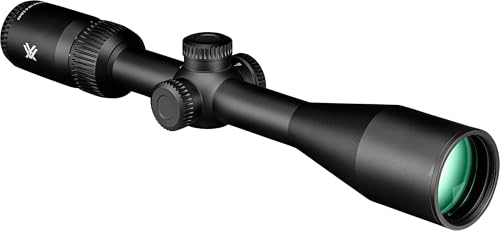
The Vortex Crossfire HD 4-12x44 is a budget hunting scope I'd recommend for a standard deer rifle out to about 400 yards, and it is the first 4-12x Crossfire I'd also put on a .22, thanks to its new side focus. Pick the plain plex for most hunting and keep the power down at dusk.
Vortex retired the Crossfire II 4-12x44 and put the Crossfire HD in its place in 2025. From across the room the two look alike. The difference that matters to me is not the HD label on the glass but the knob on the left side of the turret housing: the old scope had parallax fixed at 100 yards, and the new one focuses from 15 yards out to infinity.
That one change decides who should buy it. Below I cover what else moved between generations, which of the three reticles I'd choose, how it does on rimfire and magnum rifles, and why the top of the zoom is the wrong place to hunt with it.
At a glance
- Magnification
- 4 to 12x
- Tube
- 1 in
- Weight
- 20.7 oz
- Eye relief
- 3.8 in
- Parallax
- 15 yd to infinity
- Elevation travel
- 70 MOA
On this page
What Changed From the Crossfire II
Three changes matter, and I rank them in this order. The side focus is first, because the fixed 100-yard parallax on the old scope made it a poor choice for anything close, and that ruled out rimfire. Next comes the extra elevation travel, which gives more room to center a zero on a rifle whose base holes or receiver aren't quite true. Last is the slightly wider field of view at every power.
The price of those changes is a few ounces. I don't mind it on a standard-weight hunting rifle, but on a light carbine or a youth rifle it is noticeable. The capped turrets and the 1-inch tube carry over, so the rings you already own still fit.
If you have a Crossfire II 4-12x44 that does its job, I wouldn't replace it. If you are buying new, the HD is the one I'd want, and that's true even if you never shoot under 100 yards, because focusing out parallax at 300 yards also helps on a calm, precise shot.
Picking the Reticle
The HD 4-12x44 comes with a WideRange Plex, a Dead-Hold BDC or an illuminated Dead-Hold 2A. For most deer and elk hunters I'd pick the plex. Zero it at 200 yards with a typical .308 or 6.5 Creedmoor load and you can hold on hair out to roughly 250 or so, which covers the shots most people take.
I'd only take a BDC if you'll check every hold at real distances with your own load. With the reticle in the rear focal plane, the hash marks are only true at one power, which is the top of the zoom, and only for the class of load Vortex drew them for. At 8x they mean something different, and that catches people who never read the manual.
The illuminated version earns its place for hunters who sit on the edge of dark timber in the last light. I'd skip it otherwise, because an unlit plex is simpler and there is no battery to forget.
Dusk, Eyebox and Where to Keep the Zoom
A Crossfire that seems to go dim at dusk usually has a simple cause, and it isn't bad glass. At top power the light reaching your eye shrinks to a beam narrower than a dilated pupil, so the image darkens faster than it does at 8x. When light fades, I turn the power down before I blame the scope.
The eyebox works the same way. It is relaxed at the low end and gets small near the top, so a quick shot from an awkward rest at full power often shows a black ring. I'd hunt this scope at 6x to 8x and treat the top end as a tool for a long, braced shot.
The capped turrets are for setting a zero and leaving it. They click in quarter-minute steps and feel fine for that, but I wouldn't dial elevation on them in the field. If dialing is the plan, a scope with exposed turrets like the Diamondback Tactical makes more sense.
Rimfire, Magnums and Carbines
On a .22 the side focus is what makes this work. I'd focus it at your zero distance, often 50 yards, and refocus for the squirrel at 30. The scope is heavy for a light rimfire, so I'd put it on a full-size bolt or a target-weight semi-auto rather than a slim sporter, and I'd look at a lighter rimfire scope for a carbine-sized .22.
At the other end, the eye relief stays steady through the zoom, which I like on a magnum. It is my budget pick for a first .300 Win Mag kept inside 400 yards, and the case for it is laid out in my .300 Win Mag scope guide. Set the eye relief with your hunting coat on, since a heavy collar moves your head forward.
On an AR carbine I'd pass. The scope is long, needs a cantilever mount for a normal cheek weld, and the 4x low end is slow up close. A 1-6x on a proper AR mount is the better fit for that rifle, both for speed and for balance.
Pros
- Side focus makes it usable on rimfire
- More elevation travel than the Crossfire II
- Steady eye relief through the zoom
- Three reticle choices, including illuminated
- Fits standard 1-inch rings
Cons
- Heavier than the scope it replaced
- Small eyebox and dimmer image at top power
- Capped turrets aren't made for dialing
- BDC holds true only at top power
Neighbors Worth Comparing
- Vortex Crossfire HD 3-9x40: lighter and lower at the bottom end, the better pick for woods hunting where 4x is too much.
- Vortex Diamondback Tactical 4-16x44: exposed turrets and a first focal plane reticle if you want to dial instead of hold.
- Vortex Diamondback 3-9x40: a step up in glass in a lighter, shorter body for a rifle you carry all day, without the side focus.
Crossfire HD 4-12x44 Questions
What range is a 4-12x44 scope good for?
For a hunter holding over with a plex or BDC, about 400 yards with a standard centerfire cartridge is a sensible limit. The scope can see farther than that, but capped turrets and a second focal plane reticle make longer shots harder to do well.
Is the Crossfire HD 4-12x44 good for a .22 LR rifle?
Yes. Its side focus reaches down to 15 yards, so you can remove parallax at rimfire distances, which the older Crossfire II could not. It is on the heavy side for a light .22, and the lighter options in my Ruger 10/22 scope guide suit a small rifle better.
What calibers work well with the Crossfire HD 4-12x44?
It suits common deer and elk cartridges such as .243, 6mm Remington, 6.5 Creedmoor, .270, .308 and .30-06, and it also handles a .300 Win Mag. For a hunting rifle inside 400 yards, any of those pairs well with it.
Is a 4-12x44 good for elk at 300 yards?
It is enough scope for a 300-yard elk shot with a 200-yard zero and a suitable cartridge. Keep the power around 8x for a steadier, brighter image and save the top end for a braced shot.
What happened to the Vortex Crossfire II 4-12x44?
Vortex replaced it with the Crossfire HD 4-12x44 in 2025. The HD adds a side focus, more elevation travel and a slightly wider view, and keeps the 1-inch tube.
Final Verdict
I'd buy the Vortex Crossfire HD 4-12x44 with the plain plex for a standard deer or elk rifle shot inside 400 yards, and it is the rare budget 4-12x I'd also trust on a .22 because of the side focus. For woods hunting the Crossfire HD 3-9x40 is the better size, and for dialing I'd step to the Diamondback Tactical.